Search "Ponce Davis home prices" and you'll get two very different answers depending on which page loads first. One says homes here run from roughly $2.7 million to just under $12 million. Another says the range is $9 million to $25 million. Neither is wrong. They're describing two different neighborhoods that happen to share the same five blocks.
That gap is the actual story for anyone comparing Ponce Davis to Coral Gables or Pinecrest right now. It isn't a typo or an outdated blog post. It's a market that has split by construction vintage, and the split has been widening within the past year.
The Five Blocks Nobody Can Quite Agree On
Ponce Davis sits in unincorporated Miami-Dade County, surrounded by Coral Gables to the north, east, and south, with the city of South Miami along its western edge and the unincorporated community of High Pines adjoining to the northwest. Pinecrest lies just beyond Coral Gables' southern edge, close enough that the neighborhood is commonly described as sitting between Coral Gables and Pinecrest, even though Coral Gables itself forms the actual border on three sides. Widely repeated boundary descriptions place the core between Red Road and Old Cutler Road running east to west, and between Kendall Drive and Sunset Drive running north to south. Wikipedia's entry, which describes the community as taking its name from Ponce De Leon Road and Davis Drive, notes there are no commercial districts within it at all. Everything is residential. That's not a marketing line, it's the reason listing counts online are so inconsistent.
A search on a national portal for the surrounding 33143 zip code will surface well over a hundred active listings, but that zip code stretches far beyond the actual enclave into South Miami and parts of Pinecrest. A brokerage search filtered specifically to the Ponce Davis boundary tends to return closer to fifteen to twenty active listings at any given time. Both numbers are technically accurate. Neither tells you how many homes exist inside the true four to five block core that longtime residents and agents mean when they say "Ponce Davis."
Why So Little Ever Reaches the Open Market
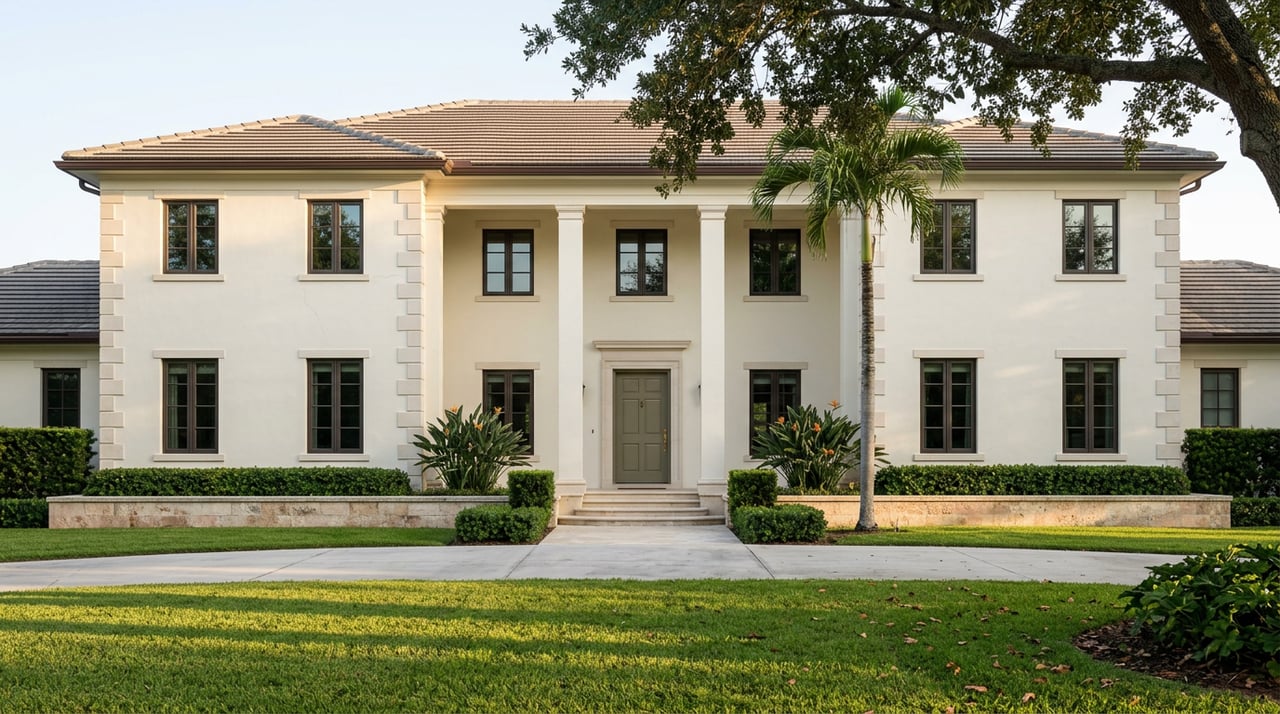
In April 2026, a national real estate news outlet covered a new listing that illustrates the point better than any statistic could. A one acre lot at 5545 SW 81st Terrace had been acquired by SL5 Developments, which built a 10,000 square foot, seven bedroom estate and brought it to market at $22 million. The listing agent, David Siddons of Douglas Elliman, told the outlet that buyers and agents regularly knock on doors in the neighborhood asking homeowners if they'd consider selling.
"Once they're in, they don't want to leave."
The home was one of only two full acre new construction properties in Ponce Davis at the time, and the other wasn't for sale. That scarcity isn't incidental to the price, it's the price mechanism. When almost nothing changes hands voluntarily, the few properties that do reach the open market get priced against replacement cost and against what a buyer would otherwise have to spend years trying to assemble through a private approach.
The Split Ceiling
As recently as last fall, an MLS snapshot of Ponce Davis listings put home prices, for the homes actually for sale, not raw land, at roughly $2.7 million to $11.9 million, with the average home measuring around 7,484 adjusted square feet. That range reflects the bulk of the neighborhood's housing stock: homes built anywhere from the 1940s through the 2010s, many needing updates, some already renovated.
By June of this year, a different picture had emerged for anything new. Land alone was commanding up to $8 million per acre, and finished new construction was landing between $9 million and $25 million, a ceiling the 5545 SW 81st Terrace listing sits right at the top of.
| Vintage homes | New construction | |
|---|---|---|
| Typical price range | $2.7M to $11.9M as of fall 2025 | $9M to $25M as of June 2026 |
| Land value | Built into the home price | Up to $8M per acre alone |
| Representative example | Average 7,484 sq ft, some built as early as the 1940s | 5545 SW 81st Terrace: 10,000 sq ft on one acre, listed at $22M in April 2026 |
| How many exist | Majority of the neighborhood's housing stock | Only two full acre new builds as of April 2026 |
Put those two rows next to each other and the confusing price guides make sense. They aren't disagreeing about the market. They're each describing a real slice of it, just not the same slice.
What Unincorporated Status Actually Buys You
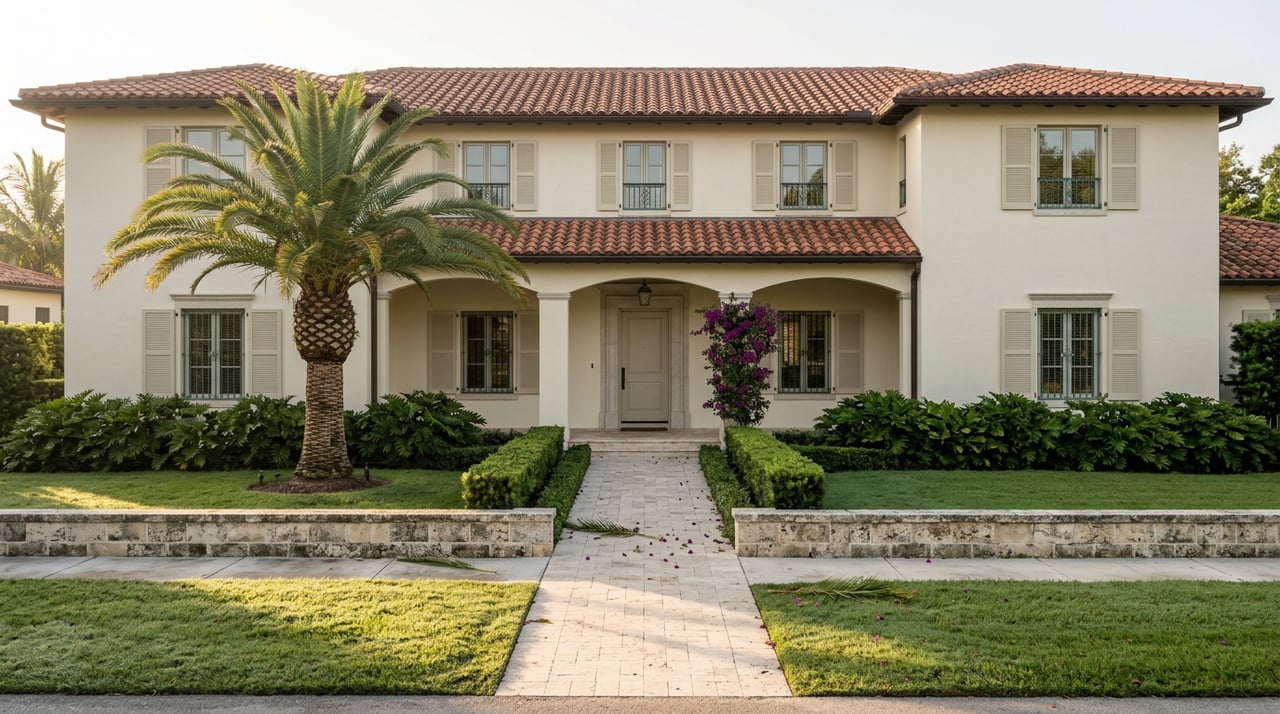
For a buyer weighing whether to renovate an older Ponce Davis home or buy a lot and start over, the neighborhood's unincorporated status is more than a jurisdictional footnote. Because Ponce Davis falls under Miami-Dade County rather than a municipal government, it isn't subject to the kind of architectural review board that governs new construction in neighboring Coral Gables. There's also no neighborhood-wide homeowners association, which means no HOA fees and no architecture committee dictating style. That's part of why the neighborhood's newer homes show real variety, from tropical modern to farmhouse influences to more traditional Mediterranean, often designed by architects like Cesar Molina and Max Strange, or firms like Choeff Levy Fischman, which has designed homes for high-profile residents including longtime Ponce Davis owner Alex Rodriguez.
In practical terms, that governance structure can shave months, sometimes close to a year, off a build timeline compared to an incorporated city with its own permitting queue and design review process. For a buyer choosing between a move-in-ready older home in the vintage price band and a ground-up build in the new construction band, that timeline difference belongs in the math alongside the purchase price.
Why the County Keeps Saying No
The unincorporated status isn't an accident of history that's likely to change soon. In 2018, the city of Coral Gables proposed annexing Ponce-Davis along with the adjacent High Pines community. Miami-Dade County rejected that proposal in 2019, along with a similar annexation attempt for the unincorporated community of Little Gables. Whatever the county's reasoning, the practical result for buyers is that the permitting and no-HOA advantages described above aren't a temporary window. They're the settled status quo, at least for now, and a buyer building here today can reasonably expect the same conditions to apply through their construction timeline.
What This Means If You're Comparing Ponce Davis to Coral Gables or Pinecrest
If you're shopping across these three neighborhoods with a single number in your head, the number is the wrong tool. Coral Gables and Pinecrest each have their own internal variation, but Ponce Davis compresses an unusually wide range into an unusually small footprint, and which side of that range you land on depends almost entirely on whether you're buying a home or buying a lot with someone else's finished vision on it.
A buyer with a $4 million to $6 million budget who wants Ponce Davis specifically should expect to be shopping the vintage side of the market, likely an older home that may need updating, competing for a genuinely small pool of listings. A buyer prepared to spend $9 million or more, or willing to buy land and build, is shopping a different market entirely, one where recent comparable sales are scarce enough that a single new listing like the 81st Terrace estate effectively sets the benchmark for everyone else.
Given how little inventory surfaces through conventional search, the door-to-door reality Siddons described isn't a quirk, it's often the only way certain properties in this neighborhood ever change hands. That makes agent relationships and local awareness worth more here than in a neighborhood where the MLS tells the whole story.
A Few Common Questions
Is Ponce Davis a gated community? No, though it contains gated enclaves within it, including one known as Stonegate. The broader neighborhood has open streets, not a single perimeter gate.
Are there HOA fees in Ponce Davis? The neighborhood as a whole has no overarching homeowners association or HOA fees, which is part of why architectural styles vary so much from block to block. Some smaller enclaves within the area may have their own private arrangements.
Can you still buy an older, unrenovated home in Ponce Davis, or is everything being rebuilt? Older homes still make up the majority of the neighborhood's housing stock and continue to trade, generally in the single digit million range. New ground-up construction is a smaller, more visible slice of the market, but it hasn't replaced the older inventory, it sits alongside it at a different price point.
If you're trying to figure out which side of the Ponce Davis market actually fits your budget and timeline, or how it stacks up against a specific block in Coral Gables or Pinecrest, that's exactly the kind of comparison worth a real conversation rather than another portal search. The Cromer Team works this corridor closely enough to tell you which listings are worth touring and which properties in this tightly held enclave might be worth a conversation before they ever reach the open market. Request a Private Consultation to start that conversation.